
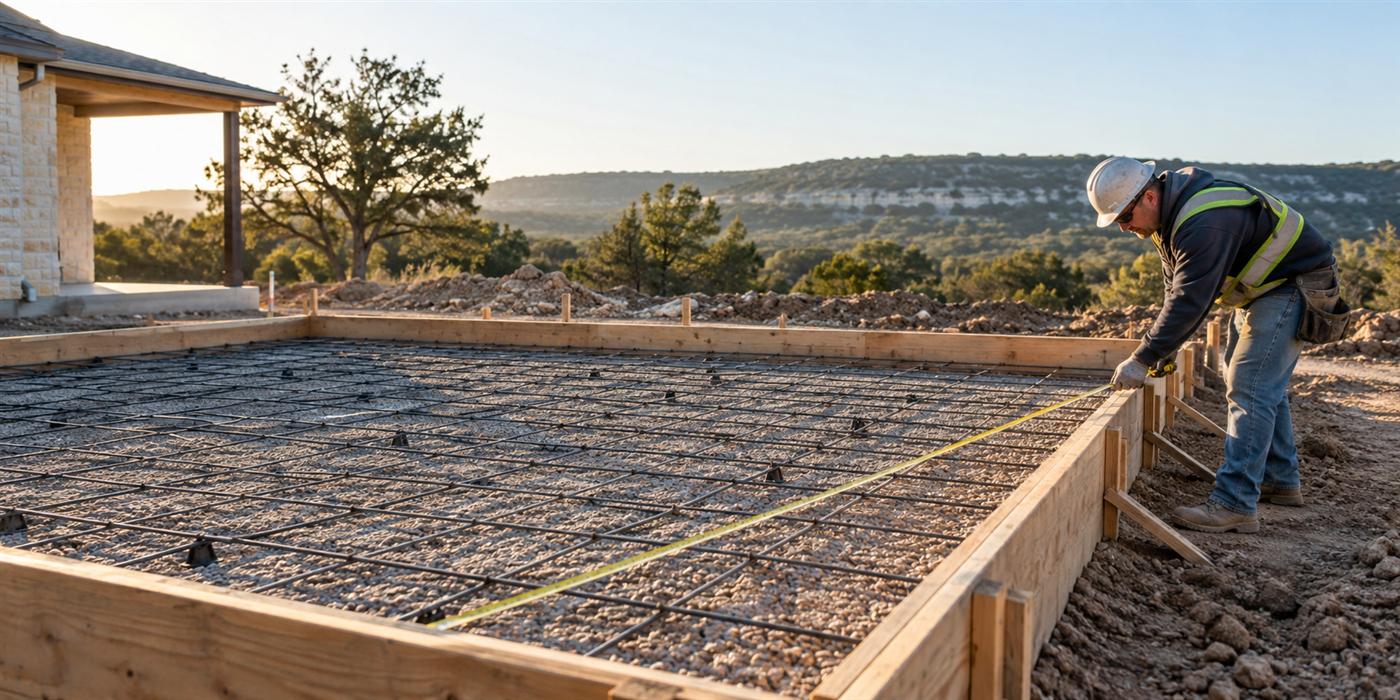
To estimate concrete for a rectangular slab, multiply the slab’s length by its width and thickness, then convert the result to cubic yards. The calculation is simple, but the measurements going into it must reflect the actual forms and excavated depth—not just the dimensions shown on a sketch.
Use this formula when length and width are measured in feet and thickness is measured in inches:
Cubic yards = length × width × thickness ÷ 324
For example, a 12-foot-by-12-foot slab that is 4 inches thick has a calculated volume of:
12 × 12 × 4 ÷ 324 = 1.78 cubic yards
That 1.78-yard result is the mathematical volume of a perfectly uniform slab. The final amount planned for a real job may be different because the subgrade can be uneven, forms may not be exact, and the design may include thickened edges, grade beams, footings, piers, or other features.
If you already have your measurements, use the Express Metered Concrete calculator to total multiple rectangles, triangles, and pier holes. If you want to understand the math and avoid the most common estimating mistakes, keep reading.
The concrete slab formula, step by step
Concrete is measured and sold by volume. In the United States, delivered concrete is commonly measured in cubic yards. One cubic yard contains 27 cubic feet.
- Measure the length in feet.
- Measure the width in feet.
- Confirm the planned thickness in inches.
- Multiply length × width × thickness.
- Divide by 324 to convert the result to cubic yards.
The shortcut divisor of 324 combines two conversions: 12 inches per foot and 27 cubic feet per cubic yard. You can also multiply length, width, and thickness in feet to obtain cubic feet, then divide by 27.
The American Concrete Institute uses this same volume method in its concrete craftsman guidance: convert the dimensions to consistent units, multiply them to find cubic feet, then divide by 27 to obtain cubic yards.
Common slab sizes and calculated concrete volumes
The table below shows the net mathematical volume for several rectangular slabs. It does not include an allowance for uneven grade, spillage, over-excavation, or design features outside the basic rectangle.
| Slab size | Thickness | Net cubic yards |
|---|---|---|
| 10 ft × 10 ft | 4 in | 1.23 yd³ |
| 12 ft × 12 ft | 4 in | 1.78 yd³ |
| 12 ft × 20 ft | 4 in | 2.96 yd³ |
| 20 ft × 20 ft | 4 in | 4.94 yd³ |
| 20 ft × 20 ft | 5 in | 6.17 yd³ |
| 24 ft × 24 ft | 4 in | 7.11 yd³ |
| 30 ft × 30 ft | 4 in | 11.11 yd³ |
These examples are useful for checking your math, but they are not slab-design recommendations. The correct thickness, concrete strength, reinforcement, base preparation, drainage, and joint layout depend on the project, loads, plans, soil conditions, and applicable requirements. Confirm those details with the responsible contractor, designer, or engineer before ordering.
Example: concrete for a 20-by-20 slab
Suppose the forms measure 20 feet by 20 feet and the approved thickness is 4 inches:
20 × 20 × 4 ÷ 324 = 4.94 cubic yards
Before treating that number as the quantity needed at the jobsite, check whether the subgrade is consistently at the planned elevation, whether the design includes thickened edges or beams, whether steps or piers are part of the same placement, and whether the forms changed after the original estimate.
A 20-by-20 slab at 5 inches thick requires 6.17 cubic yards before any allowance. That one-inch difference adds more than a full cubic yard, which is why confirming thickness matters as much as measuring length and width.
Should you add extra concrete to the calculation?
The calculated volume assumes perfect dimensions and a perfectly level base. Real placements rarely match that model exactly.
The National Ready Mixed Concrete Association advises estimating the job carefully and notes that the quantity ordered may be 4% to 10% above the plan-volume calculation to account for contingencies. American Concrete Institute craftsman guidance describes common allowances that vary with the size and conditions of the placement.
Those ranges are planning references, not an automatic rule for every project. The appropriate allowance depends on the accuracy of the excavation and forms, the complexity of the shape, expected spillage, placement method, and how the supplier meters or batches the concrete. Ask the supplier and the person responsible for placement what makes sense for the actual job.
Why measured depth causes so many shortages
Length and width are easy to see. Depth is where many volume estimates go wrong. If a slab was calculated at 4 inches but parts of the prepared area are 5 or 6 inches deep, those sections consume more concrete.
This matters on Central Texas jobsites where the prepared surface may include exposed rock, fill, utility repairs, drainage transitions, or elevations that change across the placement. The local setting does not change the volume formula; it makes field verification more important.
Measure depth at several locations after the base is compacted and the forms are set. If the plans call for thickened areas, calculate those volumes separately rather than treating the whole project as one uniform rectangle.
How to calculate thickened edges, beams, and separate sections
Break a complicated slab into simple shapes and add the volumes together:
- Calculate the main slab rectangle at its regular thickness.
- Calculate the additional volume in each thickened edge or grade beam.
- Calculate separate footings, ramps, steps, or equipment pads.
- Add the net volumes.
- Review the combined result with the contractor and supplier.
Be careful not to count the regular slab thickness twice. If the main slab calculation already includes 4 inches and an edge is 12 inches deep, the separate edge calculation should generally cover the additional 8 inches in that area—not another full 12 inches. Follow the plans and have the calculation reviewed when structural elements are involved.
What information should you have before ordering?
Yardage is only one part of a concrete order. Prepare the following before calling:
- Exact delivery address and jobsite contact
- Requested delivery date and time
- Calculated volume and how it was measured
- Approved concrete strength and mix requirements
- Slump, aggregate, air, fibers, admixtures, or other specifications when required
- Placement method, such as direct chute, buggy, conveyor, or pump
- Truck access, overhead clearance, gate width, and ground conditions
- Crew readiness and expected placement rate
ACI guidance similarly emphasizes providing the producer with the volume, delivery location and time, delivery rate, and required mixture properties. If the slab is engineered, order from the plans and specifications rather than substituting a general online recommendation.
For planning a slab or foundation placement, review Express Metered Concrete’s slab and foundation concrete service.
Why metered concrete helps when the final volume is uncertain
A careful estimate is still necessary for scheduling and material planning. However, some slabs are difficult to measure precisely even after the forms are ready.
With volumetric or metered concrete, the ingredients remain separate until the concrete is produced at the jobsite. Production can stop when the placement is complete, so the customer is not relying on one fixed, pre-batched quantity in the same way as a conventional drum-truck order.
That flexibility can be useful for small slabs, pads, additions, repairs, and projects with uncertain field quantities. It does not eliminate the need to confirm the mix design or prepare the jobsite. It reduces the practical risk associated with estimating the exact final volume before placement begins.
Express Metered Concrete serves projects from its New Braunfels and Von Ormy yards across the New Braunfels–San Antonio area. See the local service information for New Braunfels concrete delivery or San Antonio concrete delivery.
Final slab-quantity checklist
- Measure the inside dimensions of the completed forms.
- Use the approved slab thickness.
- Check depth at several points.
- Add thickened edges, beams, piers, and separate sections.
- Avoid double-counting overlapping shapes.
- Discuss a reasonable field allowance.
- Confirm the specified mix and placement method.
- Check access and make sure the crew and tools will be ready.
For a quick estimate, use the concrete calculator. For help reviewing the delivery plan for a project in the New Braunfels or San Antonio area, contact Express Metered Concrete or call (830) 627-9637.
Frequently asked questions
How many cubic yards are in a 10-by-10 slab at 4 inches thick?
A 10-foot-by-10-foot slab at 4 inches thick has a net calculated volume of approximately 1.23 cubic yards. The final amount planned for delivery may be higher if the grade is uneven or the placement includes other features.
How many cubic yards are in a 12-by-12 slab at 4 inches thick?
A 12-foot-by-12-foot slab at 4 inches thick has a net calculated volume of approximately 1.78 cubic yards before any job-specific allowance.
How many cubic yards are in a 20-by-20 slab at 4 inches thick?
A 20-foot-by-20-foot slab at 4 inches thick has a net calculated volume of approximately 4.94 cubic yards. At 5 inches thick, the same footprint requires approximately 6.17 cubic yards.
What is the easiest formula for calculating a concrete slab?
When length and width are in feet and thickness is in inches, use: length × width × thickness ÷ 324 = cubic yards.
Can a calculator tell me what slab thickness or concrete strength to use?
No. A volume calculator estimates quantity from dimensions you provide. Slab thickness, strength, reinforcement, base preparation, drainage, and jointing should come from the applicable plans and qualified project professionals.